
Introduction
Street lighting plays a crucial role in modern cities. It improves road safety, supports nighttime activities, enhances public security, and contributes to urban aesthetics. However, one major problem affects street lamps worldwide: dust accumulation. Over time, dust, dirt, sand, pollution particles, bird droppings, and moisture collect on lamp surfaces, reducing light output and efficiency.
To solve this issue, researchers and engineers have been working on self-cleaning street lamps and dust-resistant lighting projects. These innovations aim to reduce maintenance costs, improve light performance, and support sustainable urban development.
The Problem of Dust on Street Lamps
How Dust Affects Street Lighting
Dust may seem harmless, but its impact on street lamps is significant. When dust accumulates on lamp covers and solar panels, it blocks light transmission and reduces brightness.
Key problems caused by dust include:
- Reduced illumination levels
- Increased energy consumption
- Higher maintenance costs
- Shorter lamp lifespan
- Safety risks due to poor visibility
In desert regions, industrial areas, and developing cities, dust accumulation can reduce lighting efficiency by 30–60% within months.
Manual Cleaning Challenges
Traditionally, municipalities rely on manual cleaning methods. Workers use water, chemicals, and mechanical tools to clean street lamps. This approach has many drawbacks:
- High labor costs
- Traffic disruptions
- Water wastage
- Worker safety risks
- Irregular cleaning schedules
Because of these limitations, researchers began exploring self-cleaning and dust-resistant lamp technologies.
What Is a Self-Cleaning Street Lamp?
A self-cleaning street lamp is a lighting system designed to automatically remove dust and dirt from its surface without manual intervention. These systems use advanced materials, coatings, mechanical motion, or smart technologies.
The main goal is to ensure:
- Consistent light output
- Lower maintenance needs
- Longer operational life
- Better energy efficiency
Self-cleaning lamps are especially important for solar street lighting systems, where dust on solar panels directly reduces energy generation.
Research Background and Development History
Early Research Efforts
Initial research into self-cleaning surfaces began in the 1990s, inspired by nature. Scientists studied the lotus leaf effect, where water droplets roll off leaves and carry dirt away.
This discovery led to:
- Hydrophobic coatings
- Superhydrophobic surfaces
- Self-cleaning glass technologies
By the early 2000s, these materials were tested in architecture and solar energy systems.
Expansion into Street Lighting
As cities adopted LED and solar street lights, dust resistance became a priority. Research institutions and smart city programs started experimenting with:
- Nano-coatings
- Vibrating mechanisms
- Electrostatic dust removal
- Rain-activated cleaning systems
Today, self-cleaning street lamp research is an active field combining materials science, mechanical engineering, and smart electronics.
Dust-Resistant Lamp Technologies Explained
Different technologies are used to create dust-resistant and self-cleaning street lamps. Each has its own advantages and limitations.
1. Hydrophobic and Superhydrophobic Coatings
These coatings repel water and dust. When rain falls, water droplets roll across the surface, carrying dirt away.
Benefits:
- No moving parts
- Low energy use
- Long-lasting protection
Limitations:
- Less effective in dry climates
- Coating degradation over time
2. Photocatalytic Self-Cleaning Surfaces
Photocatalytic coatings, often based on titanium dioxide (TiO₂), break down organic dirt when exposed to sunlight.
How it works:
- UV light activates the coating
- Organic dust decomposes
- Rain washes away residues
This technology is already used in self-cleaning windows and is being adapted for street lamps.
3. Mechanical Self-Cleaning Systems
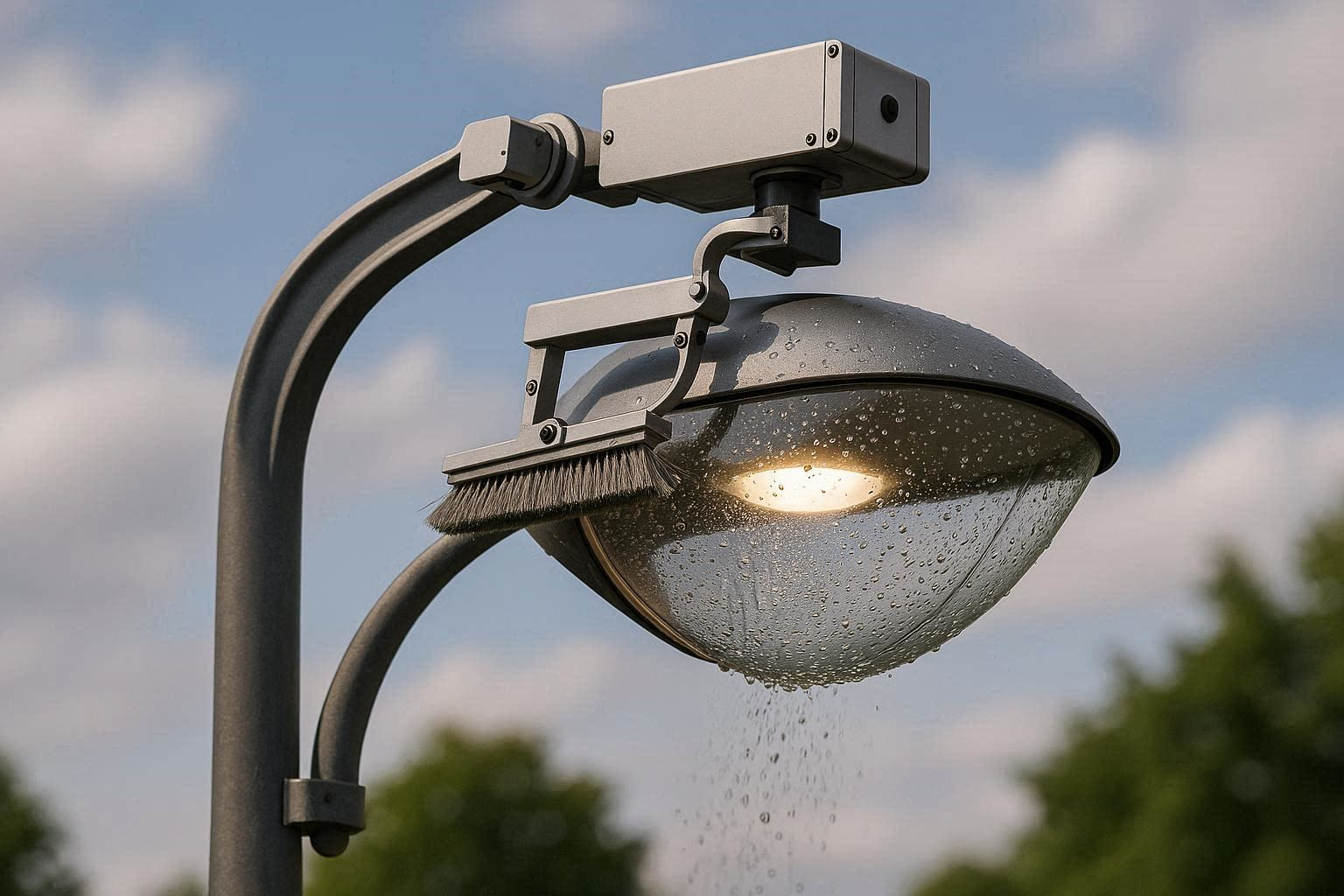
Some designs include rotating brushes, wipers, or vibration motors.
Examples include:
- Automated wiper arms for solar panels
- Periodic vibration to shake off dust
- Motorized cleaning cycles at night
Drawback: Mechanical parts increase cost and maintenance needs.
4. Electrostatic Dust Repulsion
Electrostatic systems use electric fields to repel dust particles from lamp surfaces.
Advantages:
- Effective in dry environments
- No water required
Challenges:
- Energy consumption
- Complex control systems
Existing Self-Cleaning Street Lamp Projects
Do These Projects Exist?
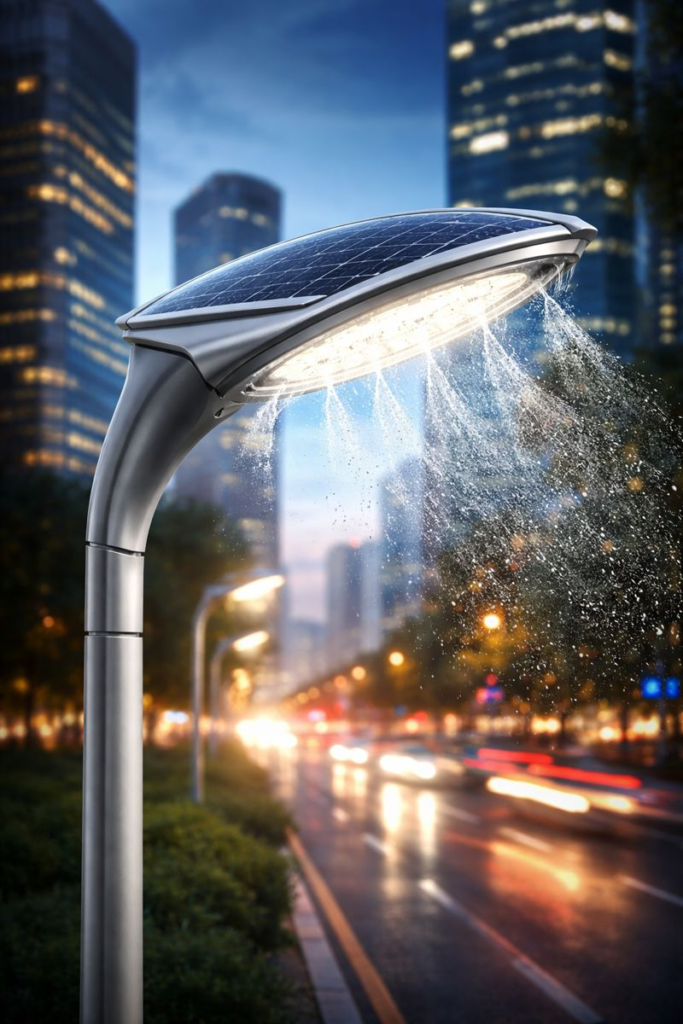
Yes, self-cleaning and dust-resistant street lamp projects do exist, both as prototypes and commercial solutions.
Many are part of:
- Smart city initiatives
- Solar street lighting programs
- University research projects
- Government-funded pilot studies
However, full large-scale deployment is still limited due to cost and environmental variations.
Real-World Examples
- Solar street lights with nano-coated panels in Middle Eastern countries
- Smart LED poles with vibration-based cleaning in industrial zones
- Photocatalytic lamp covers tested in European cities
- Hybrid systems combining coatings and mechanical cleaning
These projects show promising results in reducing dust buildup and maintenance frequency.
Comparison of Self-Cleaning Technologies
Below is a comparison table highlighting key features of different self-cleaning approaches.
| Technology Type | Cleaning Method | Best Environment | Maintenance Level | Cost Impact |
|---|---|---|---|---|
| Hydrophobic Coating | Water-based self-cleaning | Rainy or urban areas | Very Low | Low |
| Photocatalytic Coating | UV-activated breakdown | Sunny regions | Low | Medium |
| Mechanical Systems | Brushes or vibration | Dust-heavy zones | Medium | High |
| Electrostatic Repulsion | Electric dust removal | Dry, desert areas | Medium | High |
Importance of Self-Cleaning Street Lamps in Smart Cities
Supporting Smart Infrastructure
Smart cities rely on technology to improve efficiency and sustainability. Self-cleaning street lamps fit perfectly into this vision.
They offer:
- Reduced operational costs
- Improved lighting consistency
- Lower environmental impact
- Integration with IoT systems
Some smart lamps even report dust levels and cleaning status to control centers.
Environmental Benefits
Self-cleaning lamps reduce:
- Water usage
- Chemical cleaning agents
- Carbon emissions from maintenance vehicles
This makes them ideal for green city projects and climate-friendly urban planning.
Research Challenges and Limitations
Despite progress, several challenges remain.
1. Cost Barriers
Advanced coatings and automated systems increase upfront costs. Many municipalities struggle with budget limitations.
2. Climate Dependence
Some technologies rely on rain or sunlight, making them less effective in certain regions.
3. Durability Issues
Over time, coatings can wear off due to:
- UV exposure
- Sand abrasion
- Pollution
Ongoing research focuses on improving coating lifespan.
Future Research Directions
Integration with Artificial Intelligence
Future self-cleaning street lamps may use AI to:
- Detect dust levels
- Activate cleaning only when needed
- Optimize energy use
Advanced Nanomaterials
Researchers are developing:
- Longer-lasting nano-coatings
- Multi-layer protective surfaces
- Self-healing materials
These advancements could significantly improve performance.
Hybrid Cleaning Systems
Combining multiple methods—such as hydrophobic coatings with vibration—offers better results across different environments.
Economic Impact and Cost Efficiency
Although initial installation costs are higher, long-term savings are significant.
| Cost Factor | Traditional Street Lamps | Self-Cleaning Street Lamps |
|---|---|---|
| Manual Cleaning | High recurring cost | Minimal or none |
| Energy Efficiency | Decreases over time | Consistently high |
| Maintenance Labor | Frequent | Rare |
| Lifespan | Shorter | Longer |
Over a 10–15 year period, self-cleaning lamps can reduce total ownership costs.
Role of Universities and Research Institutions
Many innovations come from academic research. Universities collaborate with governments and private companies to test new designs.
Common research focuses include:
- Material science
- Energy optimization
- Environmental adaptability
- Smart control systems
Pilot projects often begin on campuses or limited city zones before wider adoption.
Global Adoption Trends
Regions Leading the Way
- Europe: Focus on eco-friendly coatings
- Middle East: Dust-resistant solar lamps
- Asia: Smart city LED pole innovations
- Africa: Low-maintenance solar street lighting
Each region adapts technology based on local climate and infrastructure needs.

Are Self-Cleaning Street Lamps the Future?
The answer is yes, but with gradual adoption.
As costs decrease and technology improves, self-cleaning and dust-resistant street lamps are expected to become standard in:
- New urban developments
- High-dust regions
- Remote and rural areas
- Smart city projects
Conclusion
Self-cleaning street lamp research is no longer just a theoretical idea. Dust-resistant lamp projects do exist, and many have already proven their effectiveness in real-world conditions.
By using advanced coatings, mechanical systems, and smart technologies, these lamps address one of the biggest challenges in urban lighting maintenance. While cost and durability challenges remain, continuous research and innovation are pushing the technology forward.